
Pandemic Anthropology Display Case Mock-up
Chicago, IL: COVID-19 Deaths, Pollution, and Structural Violence
The conclusion of recent anthropological studies is that to be prepared for the next pandemic, and reduce its impact, inequalities and injustice must be addressed.
COVID-19 Deaths per Capita by Zip
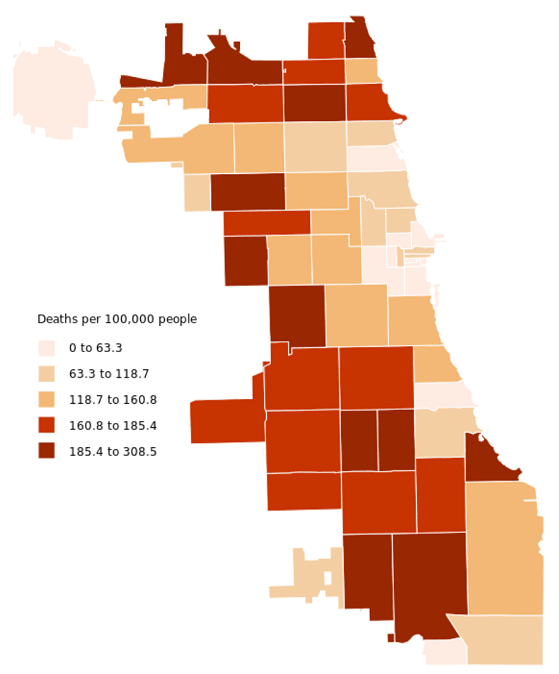
This is showing Chicago coronavirus deaths per 100,000 people by zip code as of January 2021. North Chicago has a high concentration of nursing homes, but all other areas with high proportions of deaths coincide with Black or Latinx neighborhoods that have high economic insecurity.
Recent Anthropological works have explored the interconnectedness of structural violence and COVID-19 outcomes for marginalized groups. Medical anthropology and bioanthropology stress that COVID-19 outcomes are not a biological event[1][2]. COVID-19 is a participant in an existing and entrenched social context that includes economic and political factors.
[1] Ennis-McMillan, M. C., & Hedges, K. (2020). Pandemic perspectives: Responding to COVID-19. Open Anthropology, 8(1), April. https://www.americananthro.org/StayInformed/OAArticleDetail.aspx?ItemNumber=25631&utm_source=informz&utm_medium=email&utm_campaign=cta
[2] Fuentes, A. (2020). A (bio)anthropological view of the COVID-19 era midstream: Beyond the infection. Anthropology Now, 12(1), 24–32. https://doi.org/10.1080/19428200.2020.1760635
Map Source: https://twitter.com/ChiVaxBot/status/1353885791676739585
Population by Race-Ethnicity
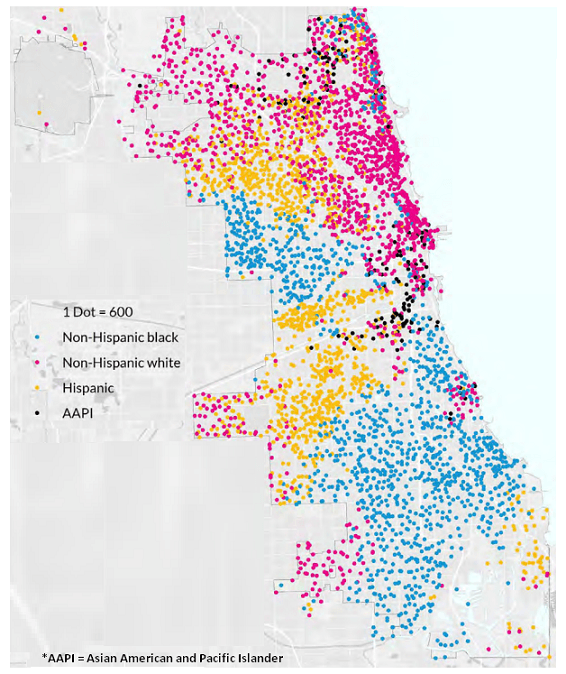
Health disparity between social groups is caused by social structures that “create and sustain conditions within which coexisting diseases and health problems flourish and interact”[1]. Disproportionately affecting the poor and disenfranchised, it is best understood as structural violence.
[1] Singer, Merrill, & Rylko-Bauer, Barbara. (2020). “The Syndemics and Structural Violence of the COVID Pandemic: Anthropological Insights on a Crisis.” Open Anthropological Research 1 (1): 7–32. https://doi.org/10.1515/opan-2020-0100
Air Quality & Health Index Score Percentiles

Pre-existing conditions, especially respiratory diseases like asthma, increase the severity of COVID symptoms and the likelihood of death. Marginalized groups live in areas higher in pollution. Pollution, which contributes to climate change, results in more people having asthma[1]. These areas are polluted more because minority neighborhoods have not been treated the same as predominately white neighborhoods by the government for decades. For instance, they have less trees [2] which causes more heat, and they are more likely than average to be near a superfund toxic dump site [3] [4]. This means that factors that contribute to climate change affect the marginalized disproportionately more [1]. COVID-19 outcomes for people of color are because of inequalities such as the unequal way that climate change affects different social groups [1].
[1]Singer, Merrill, & Rylko-Bauer, Barbara. (2020). “The Syndemics and Structural Violence of the COVID Pandemic: Anthropological Insights on a Crisis.” Open Anthropological Research 1 (1): 7–32. https://doi.org/10.1515/opan-2020-0100.
[2]“Racist Housing Practices From The 1930s Linked To Hotter Neighborhoods Today.” n.d. NPR.Org. Accessed May 10, 2021. https://www.npr.org/2020/01/14/795961381/racist-housing-practices-from-the-1930s-linked-to-hotter-neighborhoods-today.
[3] U.S. EPA, Office of Land and Emergency Management. (2020.) Data collected includes: (1) Superfund site information from SEMS as of the end of FY2019 and site boundary data from FY 2014 FOIA Request; and (2) population data from the 2015-2018 American Community Survey. https://www.epa.gov/sites/production/files/2015-09/documents/webpopulationrsuperfundsites9.28.15.pdf
[4]Miller, Elizabeth. (2018) “Waste Dumps a Burden for Minority Neighborhoods.” Accessed May 10, 2021. https://www.greatlakestoday.org/post/waste-dumps-burden-minority-neighborhoods.
Map Source: https://www.chicago.gov/content/dam/city/depts/cdph/CDPH/Healthy_Chicago_2025_Data-Compendium_10222019.pdf
COVID-19 Vaccinations per Capita by Zip
In Chicago, the most deaths per capita from COVID-19 are also the same areas that are high in pollution, high in economic insecurity, and predominately Black or Hispanic / Latinx. However, it is the areas with non-hispanic whites that were vaccinated the most by January 2021. During a pandemic the impact of inequalities, such as access to healthcare, are magnified [1].
[1]Singer, Merrill, & Rylko-Bauer, Barbara. (2020). “The Syndemics and Structural Violence of the COVID Pandemic: Anthropological Insights on a Crisis.” Open Anthropological Research 1 (1): 7–32. https://doi.org/10.1515/opan-2020-0100.
Map Source: https://twitter.com/ChiVaxBot/status/1353885791676739585